Meme Coin Trading, A Million-Dollar Playbook
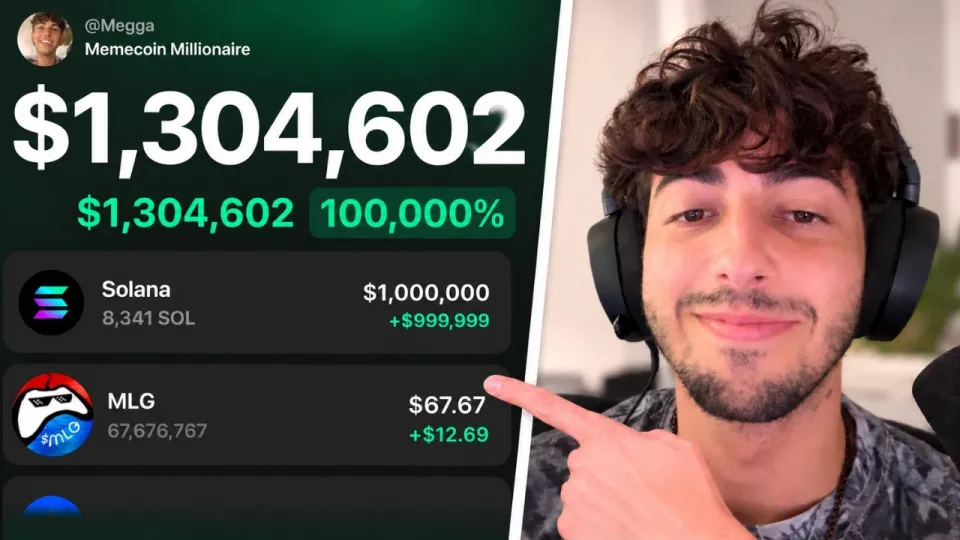
Video: How I Made $1,000,000 Trading Memecoins (FULL BREAKDOWN)
Need articles like this for your video? They help promote it on YouTube and Google — order them in the Telegram bot @sat_sit_bot. The bot writes and publishes the articles itself (with your YouTube video embedded) on popular topical websites (no ads). Free trial — 50 articles.
Key takeaways
- Megga, a former Fortnite pro, broke down a $1,000,000 all-time PnL from meme coin trading on his channel.
- The route ran through Solana trenches: early entries on low-cap launches, not long-term holding.
- Sessions of 9–12 hours a day were spent screening launches, tracking wallets and managing exits.
- Drawdowns and full losses on single positions were part of the process, not an exception.
- The biggest structural risk is being someone else's exit liquidity, which viewers flagged repeatedly.
Meme coin trading, as shown in Megga's breakdown, is a high-risk, high-attention game where a $1,000,000 result came from thousands of hours in the Solana trenches, strict position sizing and the willingness to take repeated losses. The full breakdown of that run is available through his free course signup, and the mechanics behind it are worth understanding before anyone copies the outcome.
A meme coin is a cryptocurrency whose value rests almost entirely on community attention, narrative and liquidity flow rather than on cash flow, revenue or a product. That makes it a trading instrument, not an investment thesis: the edge comes from speed, information and risk control, and the money made by one trader is, structurally, money lost by another.
What a meme coin actually is in trading terms
A meme coin is a token launched cheaply, usually on Solana or a similar low-fee chain, where price is driven by attention and on-chain liquidity rather than fundamentals. Launchpads let anyone mint a token in minutes, so supply is effectively infinite and the average lifespan of a new launch is measured in hours or days.
The practical consequences for a trader are concrete:
- Liquidity is thin and can be pulled by the deployer at any moment — the "rug" risk viewers raised in the comments is not a bug, it is the default failure mode.
- Price discovery happens in minutes, so entries and exits are decided on live data, not on charts with months of history.
- Slippage and fees eat small edges, which is why low-fee execution venues matter more here than in large-cap trading.
- Survivorship bias is extreme: the visible winners are a tiny fraction of participants, and the losers rarely post breakdowns.
Inside the trenches workflow
The trenches workflow is a repeatable screening loop: find new launches early, verify the contract and holders, size small, and exit into strength. Megga describes spending 9 to 12 hours a day on this, and the hours go into process rather than into staring at candles.
A realistic version of that loop looks like this:
- Screen launches continuously, filtering by liquidity, holder distribution and social traction.
- Check the contract for mint authority, freeze authority and how concentrated the top wallets are.
- Track wallets of traders with a documented history instead of following anonymous calls.
- Enter with a position small enough that a total loss does not change the month.
- Scale out in tranches as liquidity arrives, and accept that some positions go to zero.
The reason the workflow matters more than any single pick is that no one, including a trader with a seven-figure PnL, predicts which launch survives. The edge is in the ratio of small losses to occasional large wins, plus the discipline to keep that ratio intact.
Risk rules that separate trading from gambling
Risk rules are what turn meme coin speculation into a business: fixed position size, hard invalidation levels and a written daily loss limit. Without them, a single hot streak creates the illusion of skill and the next drawdown removes the account.
Practical guardrails used by consistent traders in this niche:
- Cap any single position at a small fixed percentage of the bankroll, so a rug is annoying rather than fatal.
- Define invalidation before entry — typically a liquidity drop, a holder exodus or a broken narrative — and exit without negotiating.
- Keep a hard daily and weekly loss limit; when it is hit, the session ends.
- Separate the trading wallet from long-term holdings and never approve unknown contracts from the main wallet.
- Log every trade with entry, exit and reason, because memory rewrites outcomes and the log does not.
Phishing and wallet drains are a separate risk category. A single malicious signature can wipe a wallet regardless of trading skill, which is why hardware wallets and a dedicated hot wallet for speculation are standard practice.
Psychology and the drawdown problem
The psychological load of meme coin trading is heavier than the technical one, because losses arrive fast and publicly while wins are rare and private. Comments under the breakdown describe exactly this: traders hitting a large multiple, then giving it back after a wallet drain or a series of bad entries, and losing mental sharpness afterward.
The pattern is predictable. After a big win, position sizes creep up. After a loss, the urge to recover immediately overrides the rules. Both moves break the same thing — the fixed sizing that makes the strategy survivable.
What actually helps is boring: return to the basics after any drawdown, reduce size, review the log, and rebuild the process at a level where decisions are calm. Consistency in execution produces results far more reliably than intensity, and a trader who cannot sit through a losing week will not sit through the winning one either.
Common questions from newer traders
Newer traders ask the same handful of questions, and the answers are mostly about constraints rather than secrets. The recurring themes are time, capital, verification and how to tell a real narrative from a manufactured one.
On time: a full-time schedule of 9 to 12 hours is what a professional run looks like, but a part-time participant can still operate with a narrower niche — one launchpad, one community, one repeatable setup — instead of scanning everything. On capital: the threshold is not a fixed PnL number but the ability to lose the entire speculative allocation without affecting rent or savings. On verification: checking contract permissions and holder concentration is basic hygiene, not alpha, and it filters out the majority of obvious traps.
On narratives: distinguishing a durable meta from a short-lived one requires watching whether new capital keeps arriving after the first wave of callers moves on. Volume that persists across several days, holders that keep growing and developers who ship visible work are the closest thing to confirmation available in a market with no fundamentals.
Useful links
- Free course signup — the training material referenced in the breakdown.
- Trading platform with low fees — the execution venue used for entries and exits.
- Twitch — live sessions and trading streams.
- TikTok — short-form clips and recaps.
- Twitter — commentary and market notes.
Final thoughts
A $1,000,000 meme coin result is a real outcome built on an unusual combination of time, temperament and risk control, and it is not a template that transfers to everyone who watches the breakdown. The transferable parts are the process: screening, verification, fixed sizing, logged trades and a hard stop on losing days. The non-transferable parts are the hours, the tolerance for repeated losses and the luck of being early on the handful of launches that actually ran. Channel Megga presents the full account of that run, including the losses, which is the most useful thing about it — the drawdowns are the part most trading content leaves out. If you want the structured version, start with the free course signup and treat every position as money you have already accepted losing.
Source: How I Made $1,000,000 Trading Memecoins (FULL BREAKDOWN) · Markdown version
Questions & answers
How much capital do you need to start trading meme coins?
There is no fixed threshold, but the practical rule is that the entire speculative allocation must be money you can lose without affecting essential expenses. Most traders start with a small dedicated wallet and scale only after a documented track record over dozens of trades, not after one lucky multiple. Starting small also keeps position sizing honest while you learn the workflow.
How do you tell a real narrative from a short-lived one?
Look for persistence rather than the first spike: volume that keeps arriving after the initial wave of callers moves on, holder counts that keep growing, and developers who ship visible work. A meta that only exists in group chats tends to collapse within days. Contract checks and holder concentration analysis filter out the most obvious traps before narrative even matters.
Is trading meme coins the same as gambling?
It becomes gambling when position size is variable, invalidation is undefined and losses are chased. It resembles trading when sizing is fixed, exits are planned before entry, trades are logged and a hard daily loss limit ends the session. The underlying assets have no fundamentals, so the discipline is the entire edge.
Can you trade meme coins part-time while working?
Yes, but not by copying a full-time scanner's routine. Pick one narrow niche — a single launchpad, community or repeatable setup — and run it during a fixed window instead of monitoring launches all day. Expect fewer opportunities and accept that you will miss most fast moves; the trade-off is a process you can actually sustain.